 Olivia Møller
Freediver - Activist - Explorer
Olivia Møller
Freediver - Activist - Explorer
Share this on
Olivia Møller
Freediver - Activist - Explorer



In recent years freediving has grown rapidly from a niche pursuit into a globally recognised sport, a form of human engagement with the sea that emphasises breath, body and minimal equipment. For many of us at Alchemy, whose work centres on freediving gear and community, this growth is not only a commercial opportunity but a moment to reflect on our responsibilities. Freediving places humans physically inside the marine environment, often in places still regarded as wild or lightly touched by people. That proximity prompts a question: what is our ethical stance when we literally touch nature beneath the surface?
The first reality to state is that the world beneath the sea is not merely a setting for human achievement. The marine realm consists of ecosystems, species and processes that have value in themselves, not just because humans may exploit, admire or conquer them. In environmental ethics, this distinction is commonly framed as instrumental value, nature as means, versus intrinsic value, nature as an end in itself. To treat the underwater world merely as playground or gym is ethically inadequate.
For freediving specifically, this means recognizing that places such as reefs, pelagic zones, underwater cliffs and deep channels support life, cycles and interactions that pre-exist human entry and will continue once we leave. When a freediver glides past a coral formation, brushes a sea fan or even enters a zone of large pelagic fish, the human body becomes another actor in the environment. That actor carries consequence.
Some might argue that freediving is minimal in impact compared to scuba or motorised diving. The argument has merit: freedivers carry no heavy equipment, often move silently and may spend less time at depth. But minimal does not mean zero impact. Contact, direct or indirect, still occurs. Disturbance, accidental damage, or simply increased human traffic can shift ecosystem dynamics.
From the perspective of an ethic of care, we ought to treat these systems with respect. One scholar describes freediving as a strategy for caring for marine environments as well as for our own bodily natures. That formulation demands a shift from performance-first attitudes, how far, how deep, how fast, to ecological awareness: into the idea that the diver’s movement is embedded in the natural world. Freediving practices therefore should begin with the question: what is owed to this environment?
The second reality is that presence itself carries ethical weight. Every freedive enters a space that is shaped by natural processes, species behaviour and physical conditions. When a diver submerges, breathing stops, weights move, fins flap, bubbles rise, even if few, and shadows shift. That act of entry alters something, even if the change is subtle.
Multiple issues arise for freedivers and freediving schools. One is the danger of habituation: when a site becomes popular, the increased number of divers may lead to repeated disturbance. Fish may change behaviour; coral may be touched or broken; sediment may be stirred. Even if a freediver aims to just observe, proximity can stress wildlife. Another is gear-induced impact: fins create thrust, chains anchor dinghies, lights may attract nocturnal species. The freediver’s body may be silent but it is not invisible.
Ethics here draws from broader environmental philosophy. For example, the discipline of environmental ethics asks: are humans simply external agents acting on nature, or are we integral parts of the ecological fabric? The answer influences how we view responsibility. If one assumes humans are separate, the automatic paradigm is domination and extraction; if one assumes humans are part of nature, then every action is relational and requires accountability.
In practice for freediving, this means instructors and individual divers should treat every dive as a potential intervention. Not because we aim to change ecosystems, but because by entering them we already change them. The ethical question becomes: how do we reduce that alteration and when must we abstain altogether? Freediving schools, tour operators and gear vendors must recognise that unregulated access, competition for novelty and social media promotion of untouched sites all carry ecological cost.
To engage this scenario constructively, we draw on three major families of ethical thinking: consequentialism, deontology and virtue ethics. Each offers relevant insights for freediving.
Consequentialism asks: what are the outcomes of our actions? In freediving terms: if freediving at site X causes reef damage, alters fish migration or increases human traffic to a delicate habitat, then the action is ethically questionable. We need to assess impact and aim for lowest harm.
Deontology focuses on duties and rules. For example, we owe respect to environments; we owe non-interference; we owe truthfulness about our practices. Equipment manufacturers and tourism operators could commit to codes of conduct for sustainable freediving.
Virtue ethics looks to character: what kind of diver do I wish to be? Do I approach the sea with humility, restraint and respect, or with conquest, spectacle and disregard? This orientation matters deeply. Environmental ethicists argue we need not only to ask what shall I do, but what kind of person shall I become.
A practical freediving ethic draws from all three. We could articulate a simple set of principles:
- Act with awareness of impact.
- Respect marine life and habitats.
- Prioritise non-disturbance above performance.
- Encourage education about ecosystems.
- Develop gear and education that minimise footprint.
When in doubt, defer to smaller acts: less disturbance, fewer pushes for novelty, more stewardship.
The gear industry is often framed as part of the problem, the one that drives consumption, novelty and extremes. Yet the industry can pivot to become part of the solution by embedding ethics into product design, marketing and partnerships.
On the design front, this means ensuring that freediving gear is built for longevity, repairability and minimal environmental cost. It means designing fins that propel efficiently, reducing the need for repeated dives simply for speed or distance. It means considering production footprints and materials sourcing. These are not add-ons but ethical imperatives.
On the instructional front, schools and charter operators should teach more than technique and safety. They should integrate an ecological module: what habitats we visit, what species we might encounter, what local pressures exist. By doing so freedivers become informed visitors, not mere thrill seekers. Research on ways of encountering water and ethics of freediving highlights that instructors have a key role in shaping the ethos of aquatic encounters.
On the commercial and marketing side, we must ask: what image are we projecting? If our blogs, social posts and events celebrate beating the deep or conquering the sea, we are reinforcing a dominant narrative of human over nature. Instead we might promote immersing responsibly, observing with care, reducing footprint. The message matters.
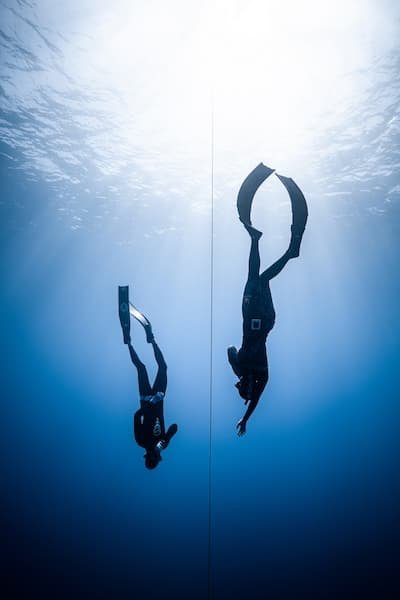
A critical issue in freediving is where access and performance culture push ethical boundaries. Freedivers are often driven by personal achievement: longer breath-holds, deeper dives, new locations. Social media valorises untouched places, secret reefs, remote drop zones. Yet each new reach invites more traffic. The same reef once isolated becomes crowded. With it comes snorkelers, boats, anchor chains, repeated entries. The performance culture of firsts or records can transform a wild site into a spectacle, thereby shifting its ecological status.
The ethical challenge is recognising that access is not always benign, and performance is not always progressive. In some cases the right choice may be not to dive a given site. Or to dive but with stricter limitations: fewer participants, longer intervals, no anchoring, strict no-touch rules. Freediving schools and industry leaders must be willing to say this site is closed or this site needs a pause when the ecological condition demands it.
Similarly, freedivers must recalibrate their metrics of success. Instead of depth alone or breath-hold time, we might recognise success as zero disturbance during dive, or observed untouched habitat and left no trace, or participated in a site restoration or monitoring initiative. Ethical freediving is not about beating nature, it is about engaging with it responsibly.
Freediving is often an individual sport. A single diver may explore in solitude. Yet when we look at ethics, the scale broadens. The individual’s actions ripple outward: dive operator policies, charter company practices, gear manufacturing and marketing, local community impacts. Freediving’s ethical framework must therefore extend to community responsibility.
Local communities where freediving takes place often depend on marine ecosystems for livelihood, culture or tourism. An influx of divers changes those dynamics. A reef that once served local fishers now becomes a destination. Freediving schools must integrate with local stakeholders: understand local rules, respect traditional use, ensure that our presence supports, not undermines, local ecology and economy.
At a global level, freediving as a sport has an obligation to engage with issues of access equity and environmental justice. Freedivers often travel internationally, bringing gear, experience and carbon footprints. The ethical dimension here includes acknowledging climate impact, including travel, supporting local conservation rather than only extracting experience, and avoiding reinforcement of destination culture that treats remote sites as playgrounds for privileged visitors.
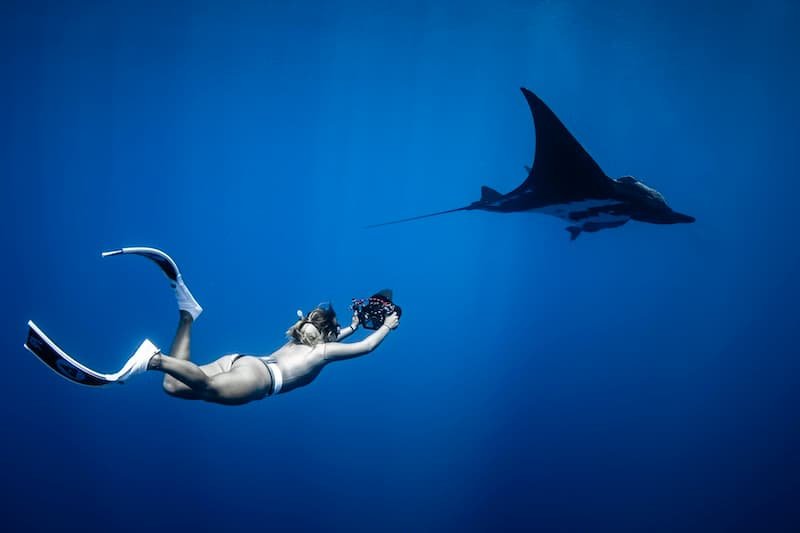
What does ethical freediving look like in practice? Here are guiding steps.
1. Pre-dive assessment: Before planning a dive site ask what is the current ecological status of the site. Is it stressed by tourism, fishing, climate change. Can we operate in a low-impact way.
2. Minimal footprint dive plan: Limit group size, avoid anchoring on coral, set no-touch rules, assign a guardian diver to monitor behaviour.
3. Gear choice mindful of environment: Use durable gear with serviceable parts, reduce consumption of single-use items, select local rental gear where possible rather than shipping equipment across continents.
4. Education and briefing: Provide divers with context: what habitats are present, what species they may disturb, what is the rule of conduct. The unfamiliar should not mean unrestricted.
5. Post-dive reflection: Evaluate: did we disturb anything, did we leave any trace, could we improve next time. This is part of cultivating a virtue ethic: the diver reflects on their actions and strives to improve character and practice.
6. Support conservation: Use dives as opportunities to gather data, support local monitoring, contribute financially or logistically to habitat restoration. A freediver’s presence can add value beyond the dive itself.
For gear manufacturers and service providers, these steps translate into design choices, warranties and communication. For example: emphasising repair rather than replacement, publishing supply-chain transparency, supporting local dive communities and including ecological briefings in every course.
Freediving ethics is not free from dilemmas. One is the dual nature of innovation and competition. New gear pushes performance which invites risk, deeper dives, more remote locations. That progression may carry more environmental risk. How do we balance the push for excellence with the duty of care. The answer does not lie in simply limiting performance but in embedding ecological awareness into what excellence means both for gear and divers.
Another dilemma is eco-tourism freediving: operators bring divers to fragile ecosystems under the banner of conservation, but if not properly managed the dive will become just another tourist impact. The freediving community must therefore distinguish between genuine low-impact access, and fast-fashion tourism dressed in reef-friendly marketing. Transparency is essential.
A third dilemma concerns unseen impacts: freedivers may leave no visible trace, but their presence still affects behaviour of marine animals, alters cycles of disturbance and recovery and may interact cumulatively with other human uses such as fishing and shipping, along with climate change. Ethical freedivers must therefore adopt a precautionary principle: just because damage is not visible does not mean there is no damage.
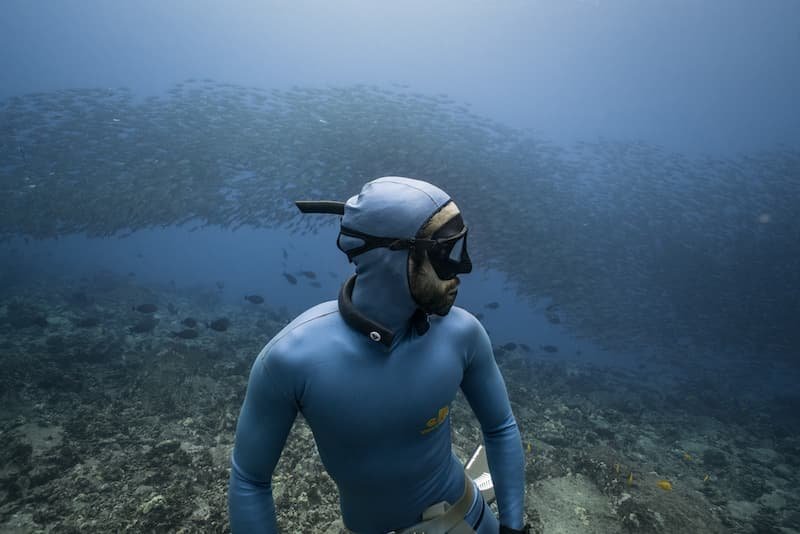
You might ask: why should freedivers care. Is not the sea vast. Will one dive matter. The answer is yes: every human action matters when scaled. But more relevant: freedivers have a privileged position. The act of breath-hold freediving creates a unique physical and observational perspective on the underwater world. That proximity brings awareness, the fins, the face of a fish, the reef, the current, and awareness brings responsibility. That insight gives us the opportunity to shift from being consumers of the underwater world to being guardians.
Gear companies, freediving schools and individual divers together can lead culture change. If we value speed and depth above all else, we tacitly accept the marine environment as a refuelling station for performance. If we value minimal disturbance, long term access and habitat health, we send the message that the ocean is not ours to conquer but ours to preserve.
Good practice in freediving ethics does not reduce performance; rather it redefines it. A dive where you leave no trace, where you observe rather than push, where you support habitat recovery, that is a performance of a different order. It is sustainable, meaningful and replicable. As an industry, that is the standard we should aspire to.
Freediving places humans inside a realm where nature operates on its own terms. It invites us to breathe in a world beyond human dominance and to engage with the marine environment physically, viscerally and ethically. The challenge is not simply how far or how deep, but how well we respect what we touch and what we leave behind.
For freedivers, instructors and gear manufacturers alike, adopting an environmental ethic means acknowledging that nature has value beyond our dives; recognising that every descent is an act of presence, not neutrality; and committing to practice, design and instruction that minimise harm and maximise care.
If freediving is to live up to its promise of intimacy with the ocean, of efficiency, of minimal gear and maximal human potential, then it must also adopt the ethics that come with that intimacy. Because the sea is not simply the place where we perform; it is the ecosystem that sustains, challenges and deserves our respect. Touching nature is a privilege and with that privilege comes responsibility.